
We arrive in Seville by bus from Malaga after a journey of almost 3 hours. The bus drops us off at the bus station « Plaza de Armas« .
Bus: Malaga – Seville
Date: May 11th, 2024 from 12:00 to 14:45
Company: ALSA
Price for 2 people: €45
Reservation: Online (https://www.alsa.com/fr/web/bus/home)
We then take a taxi that takes us to our accommodation in 15 minutes, dropping us off at the intersection of C. Villegas and C. Francos streets. We only have 250 meters to walk to reach our destination:

City: Seville
Accommodation: Holidays Isbilia Centro
Address: Calle Conteros N°2, Planta 1, Apartamento 10, 41004 Seville
Location: N 037° 23.243, W 05° 59.569
3 nights, from May 11th, 2024 to May 14th, 2024
Price: €285 (€95 / night)
Booked with Booking.com
The rented apartment is located on Calle Conteros, a lively street in the heart of Seville. The location is ideal for exploring the city on foot, being close to many tourist sites
It is a clean and well-equipped apartment, located in an authentic and charming residence. On the ground floor of the building, a magnificent garden, with seats available to residents, offers a true haven of peace in the heart of the Andalusian capital.
It is almost 4:00 p.m. and the weather is hot. We decide to stay in the apartment for a short break, then we go out around 5:30 p.m., when the air becomes more bearable, to explore the streets of Seville.
Our first stop was the famous Seville Cathedral. It is one of the largest Gothic churches in the world, impressive in its size and majesty. Built on the ruins of a mosque, it houses the tomb of Christopher Columbus. Its cloister, the Giralda, a minaret transformed into a bell tower, and its richly decorated chapels, bear witness to the city’s Christian and Muslim heritage.
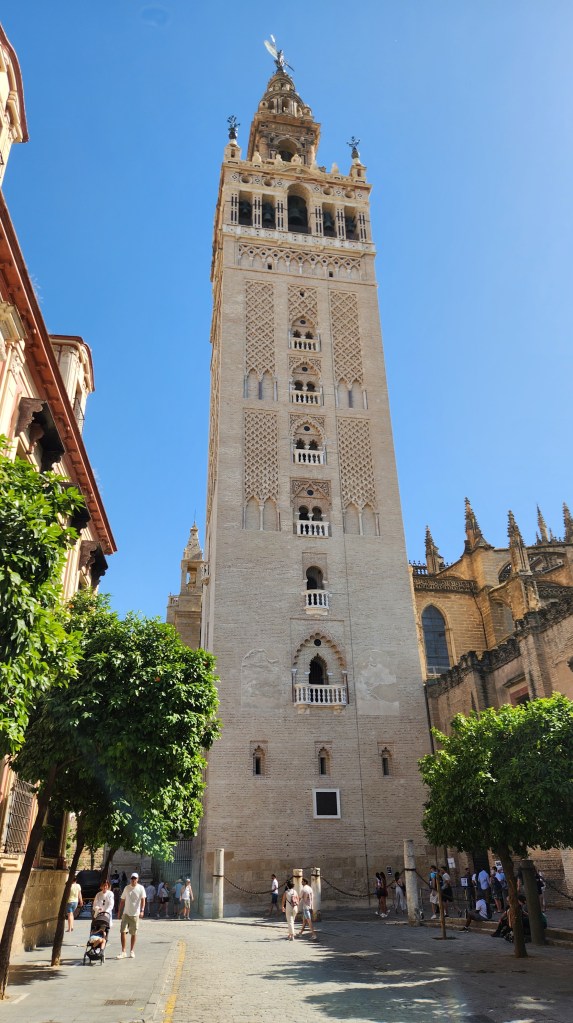
We continue our stroll through the streets of the city, without any particular objective. The streets of Seville amaze with their energy and authenticity.
We arrive at the Setas. The Setas de Sevilla, or “Mushrooms of Seville”, are a modern wooden structure located in the Plaza de la Encarnación. Designed by the architect Jürgen Mayer, this gigantic mushroom-shaped installation offers spectacular panoramic views of the city from its terrace. In addition to being an architectural masterpiece, it houses a museum, a market and public spaces, becoming a central point of Sevillian life.

We finish our walk and return to our accommodation. Among the many restaurants, we choose one with a terrace. We spend the evening there, enchanted by the excitement of Sevillian nights.
In the morning, Seville slowly wakes up. The streets are still quiet. As we pass by the Cathedral of Seville, we feel a special serenity, a city preparing for a new day.
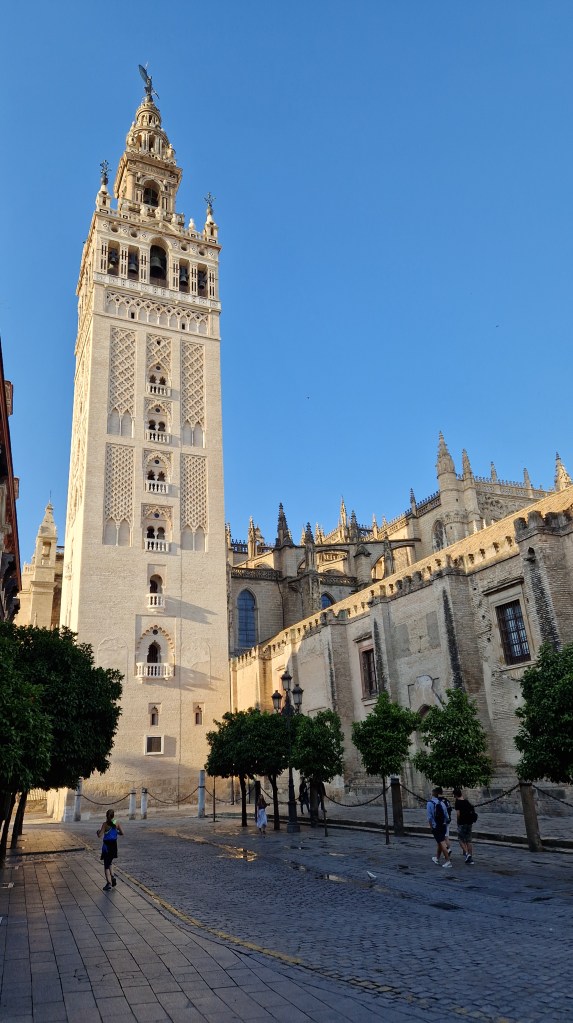
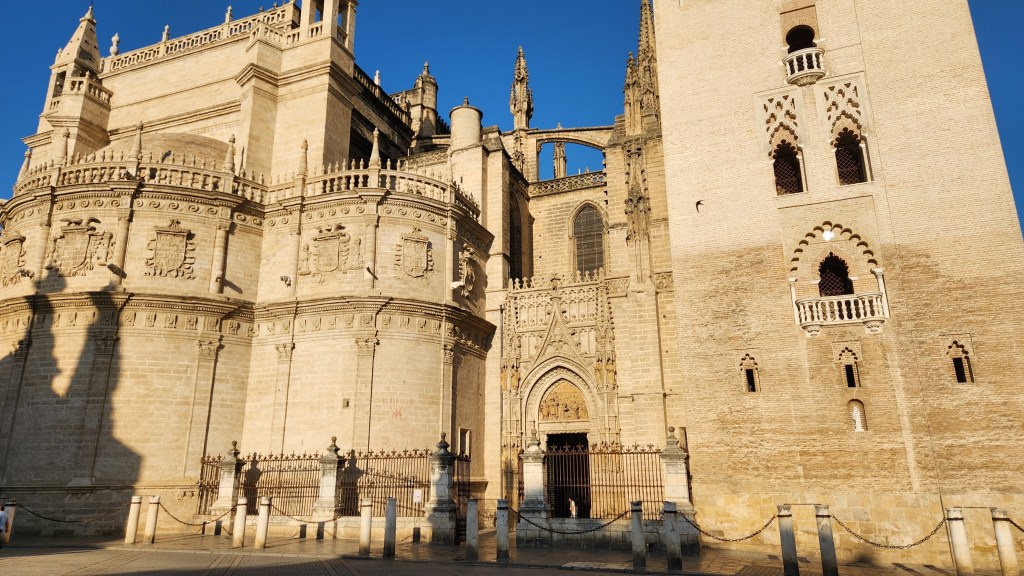
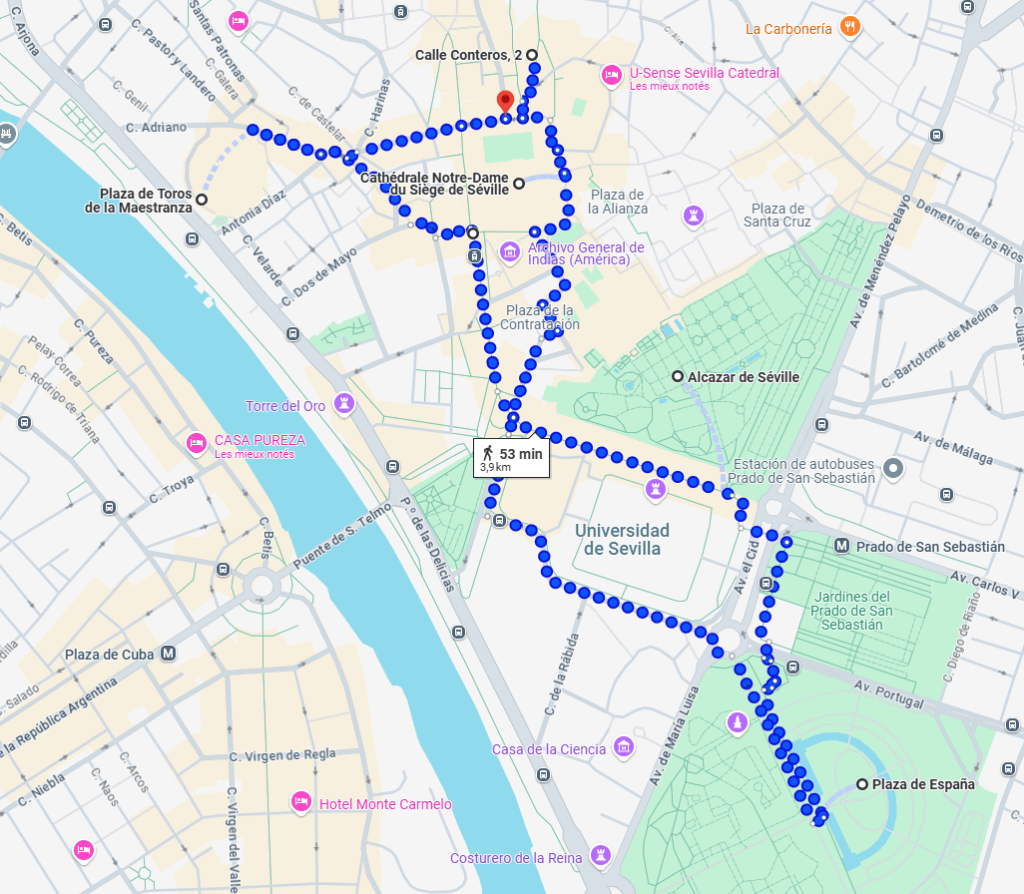
We pass by the Alcazar of Seville. It is a true architectural gem, a majestic palace with Moorish, Gothic, Renaissance and Baroque influences. Its lush gardens, its patios decorated with fountains and mosaics, as well as its sumptuously decorated rooms, bear witness to the rich and complex history of the city. Unfortunately, we were not able to visit the Alcazar, as it is imperative to book tickets two weeks in advance. To our great disappointment, the slots were already full when we arrived.
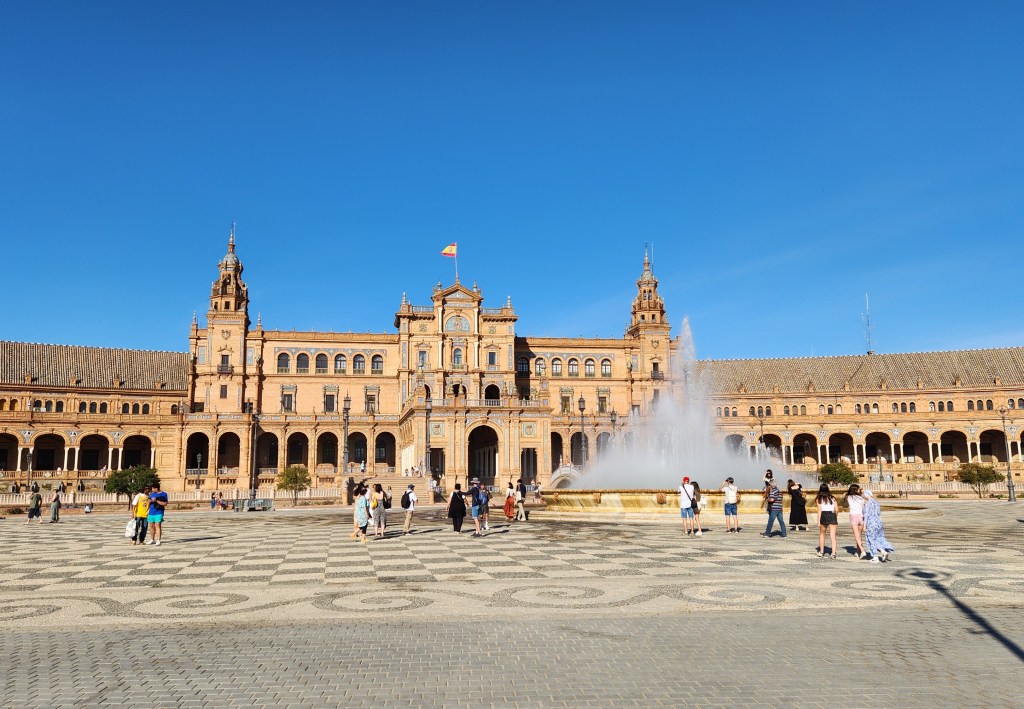
We continue our tour through charming alleys and picturesque squares, discovering the typical architecture of Seville until we reach the María Luisa Park, a large green space with tree-lined paths, fountains and statues. In this park, we find the magnificent Plaza de España.

The Plaza de España is an architectural masterpiece designed by Anibal González for the Ibero-American Exhibition of 1929. It is a semicircular square that combines Renaissance and Baroque styles, with elements of Andalusian architecture. The main building is decorated with red bricks and colorful ceramics.

A large canal crosses the square, crossed by four bridges symbolizing the four ancient kingdoms of Spain. Ceramic benches decorate the perimeter, representing the country’s provinces.

The square is an emblematic place, both majestic and popular, perfect for strolling or admiring the beauty of the surroundings.
We continue our walk by heading back to the Cathedral of Seville. We watch in wonder as horse-drawn carriages come and go, taking tourists through the city’s busy streets.

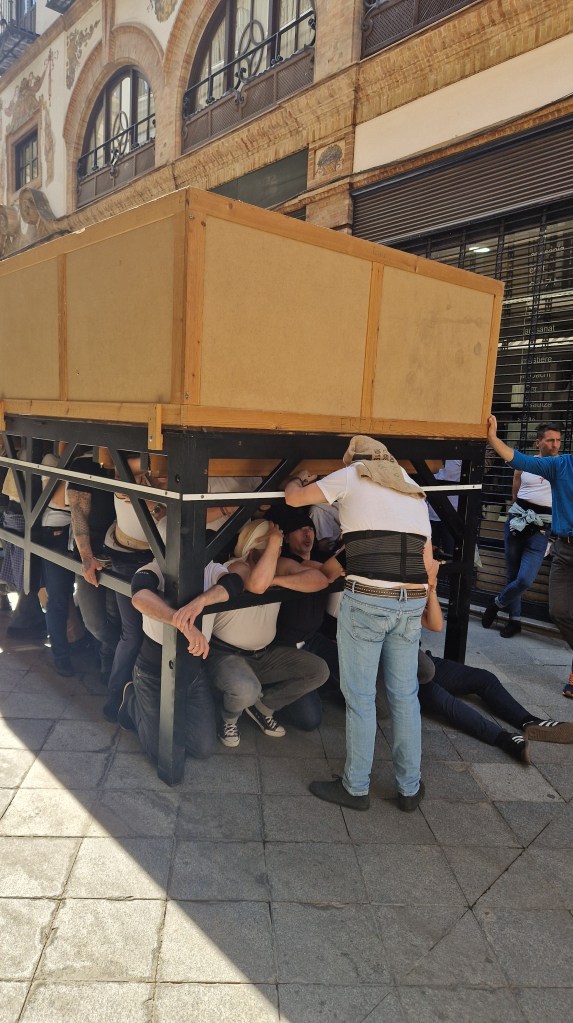
We witness an astonishing scene: men carrying an imposing wooden chest and moving forward performing a strange choreography.
Explanation :
Holy Week in Seville is one of the city’s most important religious and cultural events. Every year, spectacular processions move through the streets of the historic center, from Palm Sunday to Easter Sunday.
The men carrying a large wooden structure are called « costaleros. » They transport « pasos, » wooden platforms that support religious statues depicting scenes from the Passion of Christ or the Virgin Mary. The structure, often decorated and very heavy, is carried on their shoulders and supported by cushions (called « costales ») placed on their necks and shoulders to absorb the weight. The « costaleros » march slowly, often in groups, as part of the processions organized by the brotherhoods. This tradition is a key moment of Holy Week and symbolizes the devotion of the participants.
Even outside of Holy Week (which was our case since we were there in May), it is common for members of the brotherhoods to practice with processions or rehearsals throughout the year, often for religious events or local festivals. Although it is less impressive than during Holy Week, we were still delighted to witness this phenomenon.
We have heard a lot about bullfighting, with mixed opinions for and against. Curious to learn more, we decided to visit the museum located in the city’s bullring, the Plaza de Toros. Upon arrival, we discover a lively place, which seems deeply rooted in Sevillian life.

Surprise, tonight is the final of the Andalusian bullfighting circuit « Final del circuito de novilladas de Andalucia« . We can’t resist to buy tickets. We wanted to know more about bullfighting, and here we are.
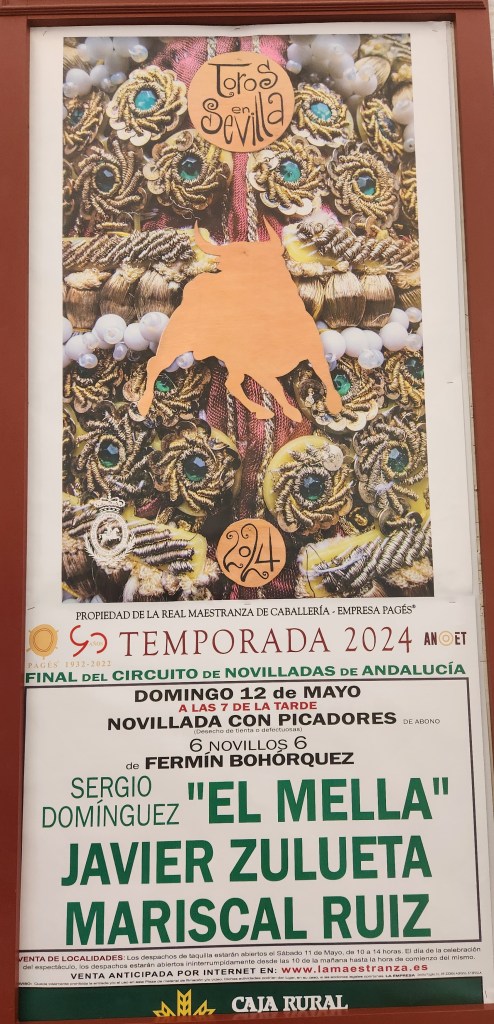
The man at the ticket office advises us on the best seats. Prices vary considerably depending on the location.

We opt for a slightly high price (€56 per person), but which guarantees us a place in the shade. And with the heat and the sun (even at 7 p.m.), we really don’t regret this choice. The show starts at 7 p.m., we return to our accommodation for a short break.
We head to the bullfighting arena. As we arrive, we see the bullfighters arriving with their equipment, while fans surround them to take photos. They are local celebrities.
The Plaza de Toros, built in the 18th century, is one of the most emblematic bullrings in Spain. Its baroque architecture, with a red brick façade, reflects the grandeur of the Andalusian bullfighting tradition. It can accommodate more than 12,000 spectators and is the heart of Sevillian bullfights. The Maestranza Museum, located inside, presents the history and artifacts related to bullfighting.
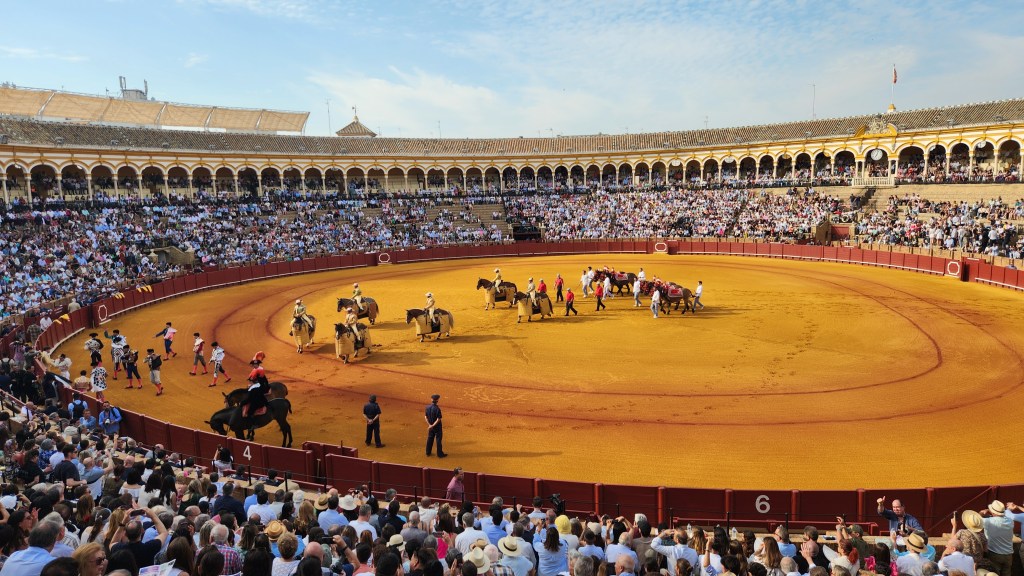
We settle in and the show begins.
The tension was palpable in the arena as the bullfighters, dressed in their traditional costumes, launched into a precise and impressive dance with the bulls. The audience, passionate and respectful, followed each movement with intensity.

We understand that bullfighting evokes mixed reactions. For some, it is a deeply rooted tradition, an art that combines courage, skill, and a form of respect for the animal. For others, the idea of suffering inflicted on the bulls is unacceptable. We do not judge either of these perspectives but we recognize the diversity of opinions on this practice. This spectacle gave us an opportunity to better understand a complex aspect of Spanish culture.
The show ends at 10:00 p.m. This experience marks the end of our day, we return to our accommodation to spend the night
We set off for a tour of the streets of Seville. Our walk began with a first stop in front of the Maritime Museum of the Golden Tower.

The Golden Tower is an emblematic monument, built in the 13th century, overlooking the Guadalquivir and recalling the time when Seville was a major commercial port. The history of trade and maritime explorations that shaped the city.

From there, we crossed the Isabel II Bridge, a metal structure that connects the historic center of Seville to the popular Triana neighborhood. This bridge, also known as the « Triana Bridge » offered us a spectacular view of the river and the banks of the Guadalquivir. The crossing was pleasant, a moment of calm before entering the beating heart of this neighborhood.

Once we arrived in Triana, we explored its covered market, a real place of life with stalls selling local products. The stalls were filled with fresh fish, quality hams, colorful vegetables and cheeses. The Triana market is not only a place where you can taste the flavors of the region, but also a space where locals and visitors meet. We took the time to stroll, admire the products and soak up the local life.
After this immersion in the atmosphere of the market, we walked the small cobbled streets of Triana, a district known for its crafts, traditional pottery and warm atmosphere. The houses with colorful facades and the many ceramic shops added a touch of authenticity to our walk.
Once our exploration of Triana was over, we crossed the Isabel II Bridge again.
Arriving on the other bank, we continued our walk towards the Setas of Seville, these gigantic wooden structures that dominate the Plaza de la Encarnación.


We found an address on the internet in this district to attend a flamenco show: « Tablao Flamenco Las Setas ». We ask about reservations.
We continue our tour in search of addresses to attend a flamenco show, this art so deeply rooted in the Andalusian identity. Flamenco shows are a must in Seville, and we were looking forward to this intense and passionate experience. Several places were recommended to us by the locals. We went around a few addresses to find out
- Tablao Flamenco Casa de la Guitarra (37°23’10.0″N 5°59’22.8″W)
- La Casa del Flamenco – Auditorio Alcántara (37°23’11.0″N 5°59’18.9″W)
- Tablao Flamenco Los Gallos (37°23’06.9″N 5°59’19.6″W)


We have understand that with our baby under 2 years old, spending an hour in a performance hall could be complicated and above all it could disturb the other spectators. We return to our accommodation to rest. We learned that there are live flamenco shows almost every afternoon in Plaza de España.
On the way back, we pass by Plaza del Cabildo. It is a small picturesque square located in the historic center. It is characterized by its quiet atmosphere, which contrasts with the hustle and bustle of the other larger squares in the city. The square is surrounded by historic buildings with facades typical of Andalusian architecture, with wrought iron arcades and balconies.

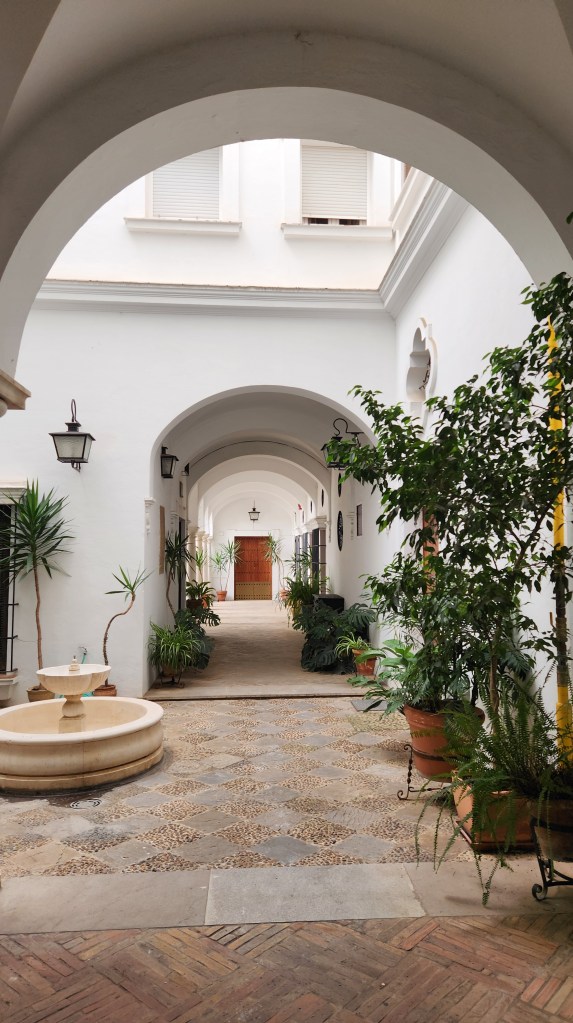
Plaza del Cabildo is often less frequented by tourists than other sites in Seville, making it a nice place to relax and observe local life.
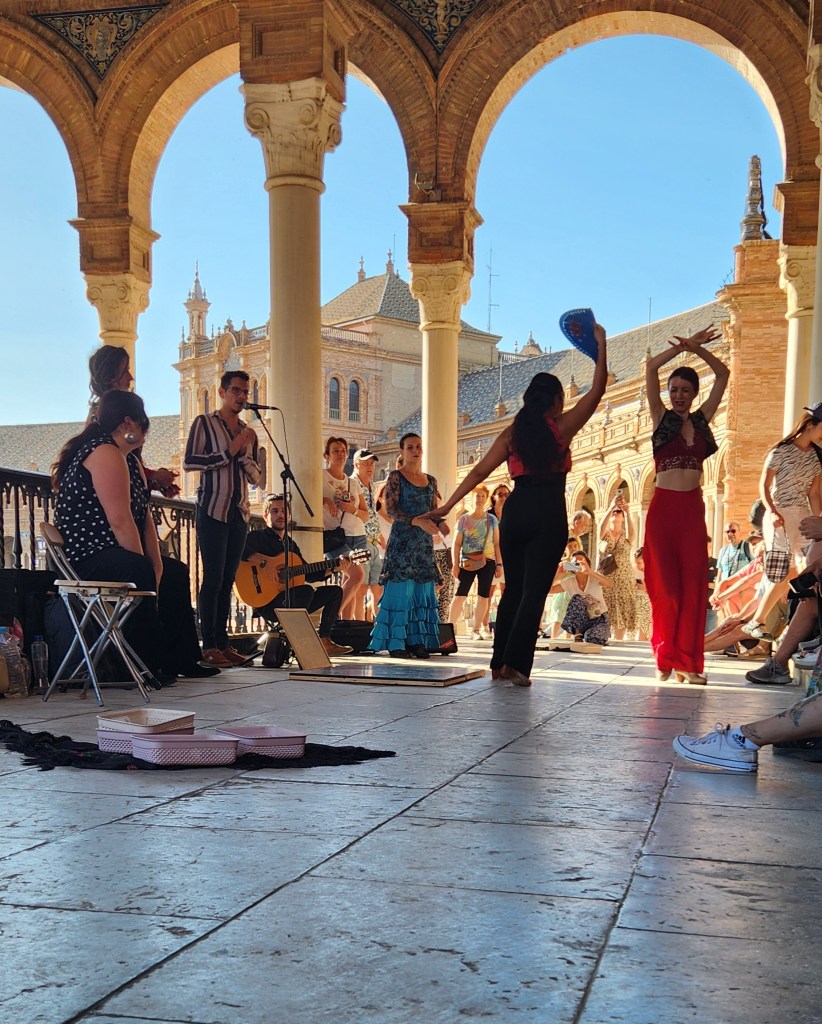
After a short nap, we head to Plaza de España, and we did not regret our decision at all. Arriving at this splendid place, we are lucky enough to discover an open-air flamenco show.

A flamenco show at the Plaza de España is an explosion of passion and movement. Under the majestic arcades, the dancers in traditional costumes hit the ground with force, their fluid and intense gestures telling stories of the Andalusian soul. The guitar, the deep singing and the clicking of heels create a captivating atmosphere, merging the energy of flamenco with the beauty of the square, for an unforgettable moment.

After this magnificent experience, we strolled through the shopping streets of the city, admiring the small craft shops and local products, such as fans or ceramics.
We end our stroll in the charming Plaza de la Alfalfa, a picturesque square in the heart of Seville, surrounded by traditional buildings in warm colors and lined with small lively streets. We sit at a café terrace to enjoy the vibrant atmosphere of the place, where locals, tourists and street performers mingle. The energy of this place, between the laughter of passers-by and the impromptu performances, is simply fascinating.
Then, we end up in the square of the Cathedral of Seville for our last evening in Andalusia.

We wake up at dawn to pick up our taxi that takes us to Seville airport. Our flight takes off at 07:30 to Brussels
Seville – Brussels
Date: May 14th, 2024 (07:30 – 10:20)
Flight duration: 02:50
Company: Vueling
Price for 2 people with a baby under 2 years old with 2 pieces of luggage: €195
Our week in Andalusia was a true immersion into the beauty and culture of this fascinating region. In Málaga, we enjoyed the gentle way of life. Marbella charmed us with its Mediterranean allure and picturesque streets. Seville, on the other hand, captivated us with its history, impressive monuments, and vibrant atmosphere.
Each city offered us a unique experience, blending discoveries, moments of relaxation, and culinary delights. This journey will remain etched in our memories, and we leave with our hearts filled with unforgettable moments. A return to reality, but with the desire to come back one day.
 my-trip-memories.com